We like to think of the Earth as stable and still, but volcanoes tell a different story. I’ve realised that I’ve visited three active volcanoes in my travels, and this post is a way of looking back at what each one revealed about the restless Earth. Standing on an active volcano, I’m reminded that the ground is constantly shifting, breathing, and remaking itself. There is a quiet sense that something is happening just out of sight below the surface, and that calm can always be broken by one of nature’s most violent events.
Mt Batur – The Quiet One

This was my first time climbing an active volcano, and the idea of doing it was partly inspired by the movie The Secret Life of Walter Mitty. Any romantic notion of conquering an active volcano like in the movies was quickly dispelled halfway through the exhausting hike up the steep, lava-covered slopes. It wasn’t quite as easy as the brochure cheerfully claimed: “It’s a relaxing hike, anyone can do it.”

I wouldn’t have guessed that Mt Batur is an active volcano, given how peaceful and tranquil the surrounding landscape is. There’s no smell of sulphur, no smouldering fires, no dramatic signs of danger. The only hints are the thin wisps of steam rising from small vents in the ground, subtle but constant. It’s a quiet reminder that the volcano is still very much alive, even if it doesn’t feel like it.

Nothing about Mt Batur felt threatening. It was calm, almost peaceful. If you didn’t know better, you could easily forget where you were. Read my previous post on climbing Mt Batur where I describe how to get there and what it was like climbing this “easy” active volcano.
Mt Bromo – The Brooding One
If Mt Batur is like the quiet person in the corner, then Mt Bromo is the brooding one, ready to vent its anger at any time. Where Mt Batur is covered in green vegetation, Mt Bromo is cloaked in ash and dust, a stark reminder that it’s still very much active.
The landscape around Mt Bromo looks like something from another planet; volcanic craters rising out of a “Sea of Sand”, all enclosed by the distant rim of a vast caldera. Sulphurous smoke drifts from Bromo’s crater, and there’s a low, constant rumble in the background, as if something is quietly stirring under the Earth.


The last eruption at Mt Bromo was in 2015 which is quite recent, and standing there on its rim you never completely forget that it could wake up again any time. Take a closer look at Mt Bromo from my recent post.
Mt Kilauea – The Angry One
If you want to see red‑hot lava up close and personal, then Mt Kilauea is the place to go. Located in Hawaii Volcanoes National Park on the Big Island, it is one of the world’s most active volcanoes and has been erupting, on and off, for around two centuries.

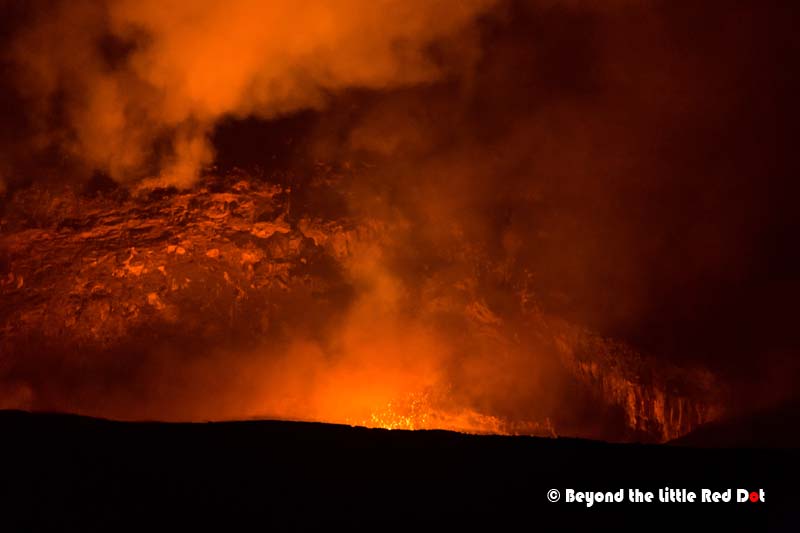
Mt Kilauea looks very different from the “classic” volcano shape of Mt Batur and Mt Bromo, with their steep cone‑shaped profiles. Kilauea is a shield volcano with gentle slopes and a broad, sprawling base. This comes from its very fluid lava, which doesn’t solidify immediately but flows for long distances before finally cooling. Because of this, I was able to see lava pouring into the sea at the coast, far from Kilauea’s main crater, as new land was slowly being built in front of me.
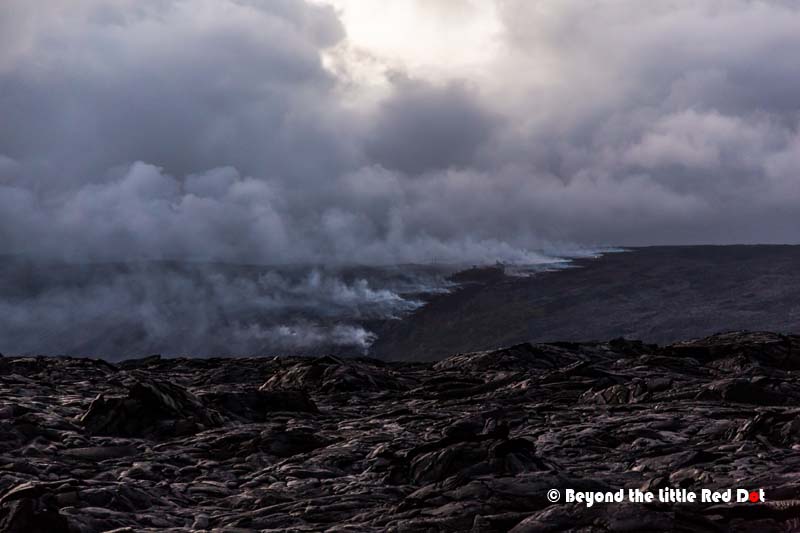


As a testament to its angry nature, Mt Kilauea is in a very active phase again in 2026, with fountains of lava reportedly shooting more than 300m into the air from its crater. For the Hawaiians, the islands are the domain of Pele, the goddess of volcanoes, and it seems that she is very angry now. Read about Kilauea and the Big Island here.
Looking back at Batur, Bromo and Kilauea, I see three very different faces of the same restless Earth. One whispers, one growls, and one roars. But all three remind me that the solid ground beneath my feet is never truly still.


Well, if you like volcanoes, you know your next-door neighbor is home to the highest number of active volcanoes in the world. You’re always welcome here.
Thanks Bama! I find volcanoes fascinating but climbing them is another story…
Fantastic photos ~ such a surreal environment, Edwin. And I have to say your ending is brilliant: “One whispers, one growls, and one roars. But all three remind me that the solid ground beneath my feet is never truly still.”
Thank you Randall.